
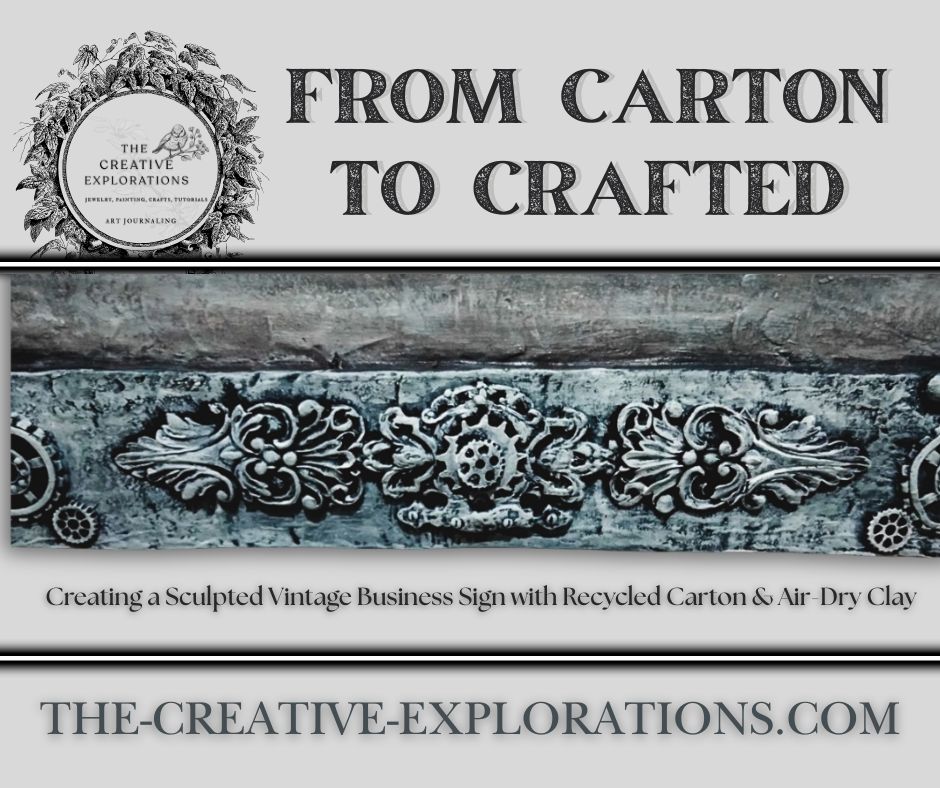


This project began as an experiment in material resilience and evolved into a DIY recycled carton and air dry clay sign that blends recycled foundations with sculptural surface design, with a waterproof finish.
It reflects my interest in combining traditional decorative techniques with contemporary problem-solving.
This post marks the opening of new categories within the blog’s creative journey: Surface Techniques, Recycle Arts, Air dry Clay, and Antique Mixed Media.
Beyond individual crafts, I am exploring how materials behave when layered, sealed, sculpted, and antiqued.

Concept & Foundation
The base of the sign was constructed using recycled carton boards, carefully layered and reinforced to create both thickness and structural stability. This approach not only promotes sustainability, but also reconsiders materials that are often overlooked in conventional design processes.
Rather than treating carton as a temporary substrate, I approached it as a structural core. The goal was to transform a material commonly perceived as fragile into something solid and enduring. By working with recycled foundations and readily available materials — not requiring specialized equipment — the process became an exploration of craftsmanship and intentional design.
Using simple tools and materials such as air-dry clay, silicone molds, acrylic paints, and patinas posed both technical and conceptual challenges.
A major challenge was addressing the inherent vulnerability of air-dry clay; its transient nature necessitated a solution to enhance its weather and time resistance.
For this project, I formulated a unique waterproofing solution that enhanced the surface strength and texture while extending its lifespan. This permanence enabled the materials to showcase their full potential — converting recycled components into a practical, sculpted business sign that honors both Art and Recycle.

Material experimantation & A Waterproofing Formula
Developing the waterproofing formula became the turning point of the project.
Air-dry clay offers flexibility and ease of sculpting, but its vulnerability to moisture limits its practical applications. If this sign were to function as a durable decorative, functional, outdoor element, the surface required reinforcement from within.
I began researching construction materials typically used for tile protection and waterproofing. From a building materials store, I selected a waterproofing medium designed to seal porous surfaces while maintaining flexibility.
What I experimented with in this project was a building-grade waterproofing product called Water Block Aqua by the brand Miercola, a clear silane/silicone-based surface protector designed to penetrate porous materials and form a breathable water-resistant barrier. I integrated it into my clay/paint compound to improve durability and reduce surface fragility. Unlike surface films or sealants that sit on top, this product works at the micro-level, helping the material resist moisture while still allowing vapor to escape — a key quality for making air-dry materials last longer in mixed media applications.
I adapted this material from construction use for artistic purposes. Always test compatibility with your own materials, work in a ventilated space, and follow all safety instructions on the label.
From there, I experimented with ratios and consistencies until I developed a compound that balanced adhesion, flexibility, and sculptability. The mixture combined:
- Air-dry clay
- PVA glue
- Water
- White acrylic paint
- Tile waterproofing medium
The goal was not simply to seal the clay, but to integrate waterproofing directly into the body of the material itself.
The addition of PVA glue increased binding strength and water resistance.
White acrylic paint helped unify the base tone and improve opacity.
The waterproofing medium enhanced resistance while preserving workability.
Water adjusted consistency to achieve a paste thick enough to hold relief, yet smooth enough to spread evenly.
Applied in layers over the reinforced carton boards, the compound adhered firmly and dried with a subtle stone-like texture. After curing, the surface could be filed, sanded, and refined without crumbling.
Once the structural layer proved stable, I could confidently move into sculpting, molding, and painting and antiquing with patinas, knowing the base would support the visual weight of the design.

Sculptural Development & Surface Construction
Matching silicone molds were selected to create repeating decorative elements that would frame the piece perimetrically. These ornamental components were cast using air-dry clay and carefully arranged along the borders to establish visual rhythm and architectural balance.
Rather than relying solely on molded repetition, I integrated hand-sculpted transitions between elements. This allowed the frame to feel continuous rather than assembled — blending floral motifs, scrollwork, and subtle mechanical details into a unified composition.
The business name and lettering were sculpted directly in clay.
This stage required patience and precision: ensuring proportional spacing, maintaining consistent relief depth, and refining curves so the typography felt intentional rather than improvised.
The entire piece — including frame and lettering — was then infused once more with the waterproofing medium. This secondary saturation reinforced the sculpted elements and ensured material cohesion before entering the painting phase.

Sealing, Priming & Structural Integration
After complete drying, the surface was gessoed to unify absorbency and prepare for painting.
Acrylic gesso served two purposes:
- To create a stable painting ground
- To visually merge all materials into a singular surface
At this stage, the sign already resembled carved stone — but without color definition.
Painting, Antiquing & Patina Work
The painting process unfolded in structured layers.
First, acrylic base tones were applied to establish depth. Neutral stone hues were built gradually, allowing variation rather than flat coverage.
A first coat of acrylic varnish was applied to seal the base layer.
This step is essential before antiquing, as it allows glazes to be manipulated without permanently staining the surface.
Antiquing Process:
- A diluted black glaze was brushed over the entire piece.
- Excess pigment was gently removed from raised areas using a soft cloth.
- This technique enhanced shadow definition and emphasized every sculpted detail.
Once the shadows were established, metallic antique patinas were introduced.
Antique gold was applied selectively to the raised lettering and focal elements.
Antique silver was brushed across ornamental borders.
A soft white dry-brush technique highlighted high points, further enhancing the illusion of carved relief.
Each metallic accent was applied sparingly — the goal was not shine, but time-worn luminosity.

Final Sealing & Permanence
After full drying, multiple coats of acrylic varnish were applied.
These layers serve as:
- Surface protection
- Moisture resistance
- Structural reinforcement
- Visual unification
The result is a piece that began as layered recycled carton and evolved into a sculptural, stone-like business sign with depth, durability, and narrative presence.

Reflection
This project is not simply about transforming carton into decoration.
It is about:
- Challenging material hierarchy
- Reimagining structural potential
- Blending construction materials with fine art techniques
- Integrating sustainability with craftsmanship
It stands as a study in permanence — created from materials often considered temporary, in a path I often explore.
- Surface Techniques
- Recycle Arts
- Air-Dry Clay Engineering
- Antique Mixed Media
Closing Thoughts
At its core, this sign features a form of Arts and Crafts that makes use of recyclable materials into something extraordinary through patience, experimentation, and a careful layering of intention.
From recycled carton boards to sculpted clay, and from construction-grade waterproofing to antique patinas, this project illustrates that craft is not confined by the status of materials — it is solely determined by imagination and persistence. Permanence involves more than just intricate supplies; it often depends on a deep understanding of structure, chemistry, layering, and the effects of the techniques used.
This project marks the beginning of a deeper exploration into surface techniques, altered art and mixed media, air dry clay and structural reinforcement and artistic expression — themes that will continue to unfold across future posts.
If this process resonated with you, you can explore more projects and techniques at:
🌿 The Blog
https://the-creative-explorations.com/
🌿 Pinterest – Sharing and Curating Ideas and Inspiration
https://pin.it/erWTBUDL4
🌿 YouTube – Step-by-Step Tutorials
https://www.youtube.com/@the-creative-explorations
🌿 Facebook – Process Glimpses & Updates
https://www.facebook.com/profile.php?id=100091428296051
And every experiment can be the potential and dynamic of an ongoing creative journey.
Welcome to the next chapter of The Creative Explorations.










Leave a Reply