


Teardrop Bezel & Assembly
In Part 1, we created bezels for the round crystal studs using even-count circular peyote.
You can preview Part 1 in the video below or follow the link for the full written tutorial on the 10 mm round bezel and stitch instructions.
In this part, we move to shaping the 13×18 mm teardrop crystal.
Unlike the round studs, the teardrop requires intentional shaping of our stitched beadwork.
To achieve the elegant tapering form, we work in odd-count circular peyote stitch, allowing the beadwork to naturally follow the narrowing tip of the crystal

Understanding Odd-Count Circular Peyote Stitch
Unlike even-count peyote stitch — where the bead count is divisible by two and the “step-up” falls naturally into place — odd-count peyote requires a controlled structural shift.
Because we begin with an odd number of beads, the beadwork cannot align symmetrically. Instead of finishing a round facing a single bead, we arrive at two adjacent beads at the end of each round.
This “double-bead moment” is not a mistake.
It is the structural principle that allows us to taper and shape the bezel.
We’ll tackle the process one step at a time, beginning with collecting all the materials we’ll need.

Materials for the Teardrop Bezel
We will need:
• 13×18 mm teardrop sew-on crystal (rose montee)
• Size 11/0 glass seed beads (main structure)
• Size 15/0 Delica seed beads (tightening rows)
• Transparent nylon fishing line (0.20 mm recommended)
• Size 10 or 12 beading needle
• 3 mm jump rings
• Earring studs or ear wires
I prefer transparent nylon fishing line because it remains invisible between stitches and is extremely durable.
A 0.20 mm thickness allows you to pass through your beadwork multiple times without stressing the beads — which is essential when reinforcing and tightening the bezel.

Foundation Ring
Begin by cutting a comfortable working length of beading thread. For this bezel, I use approximately 70 cm of nylon thread.
Add a stop bead near the end of your thread, leaving a 10 cm tail that will later be woven in to secure the knot. The stop bead simply prevents the seed beads from slipping off while you form the foundation and will be removed later.
String 31 size 11/0 seed beads and pull them down to the stop bead. Form a ring by passing your needle back through all 31 beads.
Reinforce the ring by weaving through all 31 beads at least twice, omitting the stop bead. Once reinforced, tie a small, secure knot between two beads, pass through a few additional beads to hide the knot, and remove the stop bead.
The choice of 31 beads (an odd number) is intentional. The exact number may need slight adjustment depending on the precise circumference of your teardrop crystal, but it must remain an odd number in order to work odd-count circular peyote stitch, which allows the bezel to taper and follow the elongated shape of the stone.

Rounds 1–3: Structural Shaping in Odd-Count Peyote
Round 1 – Establishing the Offset
Begin odd-count circular peyote:
• Pick up one 11/0 bead
• Skip one bead in the foundation ring
• Stitch into the next bead
Continue around.
At the end of Round 1, you will face two adjacent beads.
To step up:
• Pass through both of these beads
• Then pass through the first raised bead of the round

Rounds 2 & 3 – Managing the Two-Bead Space
Continue in peyote rhythm:
• Pick up one bead
• Skip one bead
• Stitch into the next raised bead
At the end of each of these rounds:
• Add two beads into the two-bead space to maintain structural balance.
By the end of Round 3, the bezel will begin to visibly follow the teardrop contour.
Completing Round 3 & Forming the Tip
At the end of Round 3, one peyote stitch will appear visually “missing” in the two-bead area.
To complete the round evenly:
• Add one bead to fill that missing position.
Now we change direction.
To return to the two-bead space:
• Follow the natural peyote thread path
• Pass through a bead below
• Reinsert your needle into the first of the two beads from the previous round
You are now positioned at the top center of the teardrop.

Adding the 15/0 Center Bead (Defining the Tip)
Now introduce your first 15/0 Delica bead.
• Add one 15/0 bead between the first two beads of the two-bead space.
To anchor and center it precisely:
- Add the 15/0 between the first two beads
- Weave down through one bead of the lower two-bead sequence
- Pass back up through the 15/0
- Pass through the opposite lower bead
- Return again through the 15/0
This weaving pattern centers the 15/0 bead exactly between the four beads formed in Rounds 2 and 3.
This bead becomes the highest point of the teardrop..
Preparing to Bezel the Front Frame
After securing the first 15/0 bead at the top center of the teardrop, reposition your thread.
- Weave your needle naturally through the beadwork
- Exit on the opposite side from where you were working
You are now positioned to begin peyote stitching the front frame of the bezel — the side that will visibly highlight the crystal.

Bezel the Front Frame
Reposition your thread:
• Weave naturally through the beadwork
• Exit on the opposite side from where you were working
Work one full round of peyote using 15/0 Delicas (light silver in this design).
This round highlights the crystal and creates a refined, tight frame.
As you stitch:
• Maintain firm but controlled tension
• Gently guide the beadwork inward
After completing the round:
• Reinforce by weaving through the 15/0 round at least twice
Avoid excessive passes — 15/0 beads are delicate.
A size 12 needle is particularly helpful at this stage, especially for beginners. The thinner needle allows smoother re-entry through our beadwork without forcing the thread.

Securing the Back of the Bezel
Reposition your needle to the back side.
Insert the crystal into place.
Work two additional rows of peyote with 15/0 Delicas on the back frame to tighten the structure and lock the crystal securely.
Weave through your beadwork multiple times to reinforce.
When properly tightened, the crystal should feel firmly secured without glue.

Ladder Stitch Connector
Using the centered top 15/0 bead as your anchor:
- Add three more 15/0 Delicas in the same color
- Stitch down into the center bead directly opposite the tip
- Pull snugly to form a small beaded loop
- Reinforce by weaving through the loop and anchor beads at least once more
This creates a small beaded “ring” — the connector.
This loop will later hold the 3 mm jump ring that joins the teardrop to the round stud.
It ensures alignment, balance, and long-term strength in the final earring assembly.

Final Assembly — Joining the Bezels
Step 1 — Connect with Jump Ring
Using a 3 mm jump ring:
- Open by twisting sideways
- Insert through the ladder-stitch loop
- Attach to the round stud connector
- Close securely
Ensure alignment before fully closing.
Step 2 — Attach Stud or Ear Wire
Apply a small amount of jewelry glue to the flat pad of your stud.
Press onto the back of the round bezel.
Allow to dry completely.
Optional: replace studs with ear wires for a more fluid drop design.
• Ensure the connector loop is centered
• Confirm the jump ring is fully closed
• Gently test the bezel’s firmness
A well-constructed piece should feel secure and balanced.

Enjoy 💜
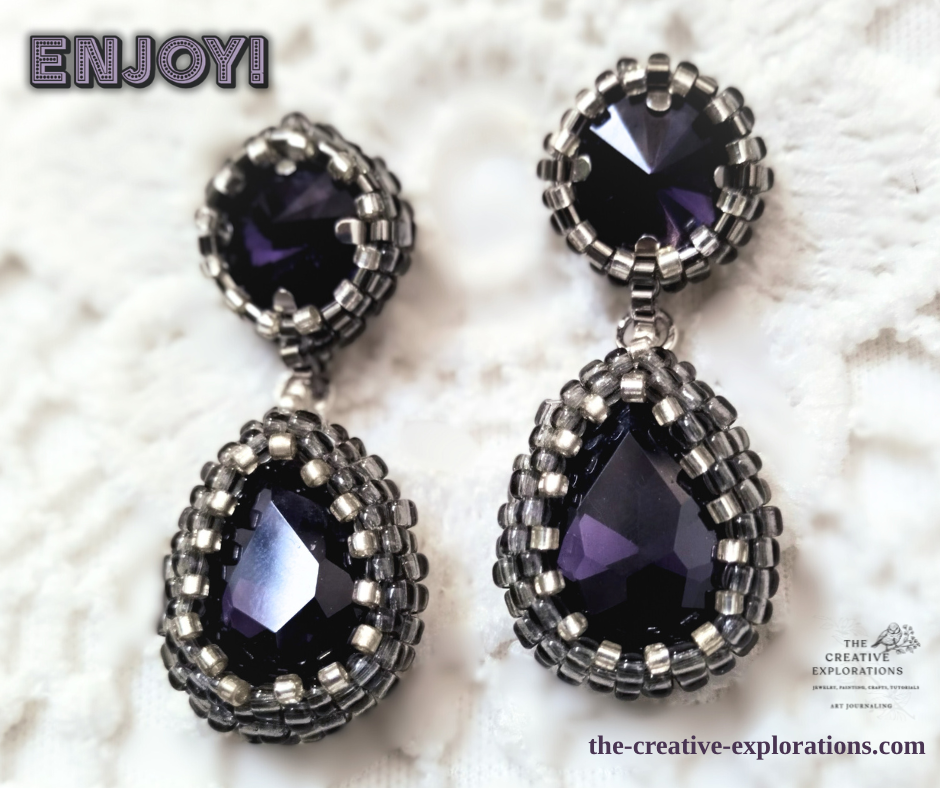
With both bezels completed and assembled, your bezeled crystal earrings are ready to wear.
The contrast between structured silver seed beads and deep amethyst crystals creates a timeless design that can be adapted in endless variations.
Try:
• Different crystal shapes
• Gold or bronze palettes
• Monochrome tones
• Gemstone cabochons
Once you understand even-count and odd-count circular peyote, the design possibilities expand beautifully.
Continue the Creative Journey
✨ Part 1: Round Crystal Stud Bezel
✨ Part 2: Teardrop Bezel & Assembly (current tutorial)
If you found this tutorial helpful:
• Subscribe for future bead weaving projects
• Join The Creative Explorations on Facebook
• Follow on YouTube for full video walkthroughs
• Share your finished earrings — I would love to see your version 💜
Thank you for visiting,
The Creative Explorations















Leave a Reply